
Three months ago, I started what I have come to call my “family sabbatical”. This elaborate title is code for the far simpler fact that I’ve taken a year off from work, to tend to some family needs.
Don’t get me wrong, this was not a simple decision. There was months of pondering, talking, debating, weighing pros and cons, self-reflection, and even arguing, before husband and I decided this was right for us. And while my kids’ needs are paramount, this was not the only factor that went into this decision. Far from it. I had to take a hard look at where I was at in my career, in my life, in my marriage, and in my family. I had to consider who I was, who I wanted to be, and where my dreams were hiding.
But the most interesting part about this journey, so far, has been the revelation that I am not alone. While I’ve joked, and daydreamed, with colleagues and friends over the years about leaving our jobs, and focusing on what mattered in our respective lives, I never really believed that any of us would seriously consider it. Until I did.
And now, I’ve become a canary in the coal mine. These same friends and colleagues look at me with bemused interest and uneasy curiosity. They want to know, why I did it? What am I doing with my time? Do I miss work? Am I happier? What does it feel like? I sometimes feel like they’re looking at me like a kid would gawk at chocolate-covered broccoli; they’re tempted by the chocolate, but having trust issues with the broccoli.
So, this letter is to all those friends and colleagues in the hopes that I can provide some insights. They may not be entirely satisfactory, but I hope there is enough to help those of you considering your own paths.
Dear friends:
I’ve lied to you.
I didn’t know I was doing it at the time, of course, but with hindsight comes some clarity. Over the years, I’ve said to many of you that I would have no problem taking that step, when it was time for me to leave work. That if I won the lottery tomorrow, I had a bucket list as long as my arm, and ambitions for a second life in retirement. I bragged that I would fill my days with things I WANTED to do, instead of things I HAD to do.
And while the bucket list is indeed real, and I still have some fabulous plans for “Freedom 50+”, I completely misjudged how difficult it would be to actually step away from my career.
I was getting through life just fine, after all. I had accomplishments, a good career, trusted colleagues. I was reasonably happy, with healthy, well-adjusted kids, and a strong marriage. I liked where I lived, was financially comfortable. I maintained fulfilling friendships.
The bottom line was that I was not unhappy with my life. Sure, I was stretched and stressed, but wasn’t everybody? I was meeting expectations, and in some cases, exceeding them. And so, the question of whether to step back from work seemed, initially, to be a ridiculous indulgence. I was doing just fine, thank you, and my challenges were no different from everyone else’s.
And yet, once the notion wormed its way into my brain, it was like a mosquito in the dark. Quiet for a moment, and then buzzing again in my ear, making it impossible to settle back into restfulness. With the buzzing, came the questions. Can I really manage my kids’ needs and maintain the current tempo? Am I enjoying this pace and intensity? Am I present in what is happening to me or am I just getting through the day, getting through my life? Is getting through enough for me? Or do I want my days to be different? Am I where I want to be at any given moment in my day?
And once I started asking these questions, and truly considering them, it was like a veil was lifted. I started to see my life from a new angle, and I only had more questions. Was it normal for my blood pressure to go up 20 minutes before I needed to leave work, because there wasn’t any room for slippage in the evening schedule? Was it healthy that I could read several pages of a book to my kid, and have no recollection of what I’d read, because I was thinking of all the tasks I needed to get done at work the next day? Was I being who I wanted to be when I spent every run with a friend ranting about the latest issue rattling around in my brain, instead of investing my time in that friendship and enjoying the endorphins? Was I insane to even be considering stepping away from a career that I had spent 20 years building, just so life could be a little easier?
What finally dawned on me is that all of us spend our lives working several jobs. Sure, we have our careers, but there are other parts of our lives that take up just as much energy. We are children, parents, siblings, life partners, friends and community members. On any given day, we move back and forth between each of these roles. Some days, we knock it out of the park; other days, we drop every last ball, and watch them roll around aimlessly, before picking them back up again.
After all these questions rattled around noisily in my brain for some time, I finally decided that, in fact, I was tired of juggling. I was tired of spending every waking hour concentrating solely on the balancing act. I wanted to set one or two of the balls down, and stop careening around wildly to keep them all balanced. I wanted to take a step back, and focus on being a better juggler, and have a chance to watch my act. You see, I’ve come to realize that my life is one hell of an incredible show, and I was missing huge chunks of it.
All that consideration and rumination seems easily summarized in a pithy blog post. But the blunt reality is that it took me months to work through all these questions. In the end, taking the leap required that I overcome two ingrained, ever-present and crippling fears. The first was the fear of “they”. We all know who “they” are, though we’d be hard pressed to identify them. It is who we are referring to when we say to ourselves, what will “they” think? Will “they” say I couldn’t cut it? Will “they” think I was lazy? Indulgent? Weak? It was only when I managed to ask myself who exactly “they” were, that I was able to step outside that question and see that the omni-present “they”, were, in reality, only my own insecurities personified. In accepting that, “they” lost power over me, and it felt good to get away from the judgmental bastards.
The second fear is much harder to overcome, and I’m still working on it. It is the very basic, yet terrifying, fear of failure. In unshackling myself from some of the demands of the ‘have to do’s’, it opened a path for the ‘want to do’s’, and that was the ‘road less traveled’. What if being home makes no difference in my family’s life? What if I step back from my career and nothing feels different? What if I’m wrong about my assumptions and this is not the solution? What if giving myself this time proves that I was kidding myself about that bucket list, and the dreams die under the weight of expectations?
I was walking by a little family run restaurant the other day. It’s one of those small places that always seats customers by the front window to make it look full of happy patrons. A family was just arriving; mom, dad, and a little guy about 4 or 5 years old. While talking to her husband, mom was taking off the little guy’s hat, mitts, coat. Her eyes were on her husband, with occasional little darts to the kid, as her hands mindlessly performed tasks she’d probably done a million times. I bet if I asked her what article of clothing she removed first, she’d have no idea. She may not even remember having done it in the first place. And it struck me, that’s how I had been living my life; eyes ahead focusing on the next thing while I unconsciously went through a myriad of little actions. Some of these are meant to be mindless. Do we really need to be conscious that we are locking the door that we’ve locked thousands of times? But where is the tipping point? Where is that moment where you are missing the stories, missing the smiles, missing the tears, missing your life?
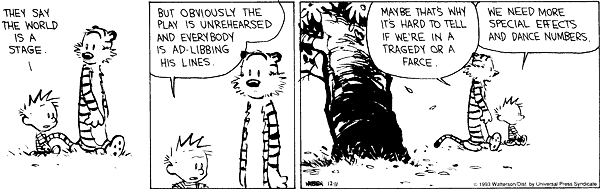
If Shakespeare was right that “All the world’s a stage/ And all the men and women merely players”, then I am still figuring out my part. I freely admit, that even 3 months into my sabbatical, I am still wrestling with the fears, and I don’t know if I’ve made the right decision. What I can tell you is that I am not suddenly a perfect parent, my child’s learning challenges have not magically dissipated, nor have I managed to write the great Canadian novel now that I am freer to do so. But, I feel more like myself than I have in years, I look forward to every single day, and I am writing this post today. It doesn’t mean every day is perfect, nor that I’m suddenly knocking every day out of the park. For me, it means that my juggling act is getting a little better with each passing day, and I am a sentient actor on the stage that is my life. I am not parroting the lines, nor going through the actions mindlessly. Rather, I am helping to shape the plot as I go, and responding honestly and mindfully to the twists that are put in front of me. And, for now, I like how that feels.


 Median Mama