
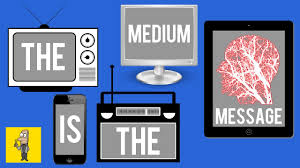
 In 1964, the Canadian English professor, elevated to popular commentator, Marshall McLuhan coined a phrase that has become a throw-away truism for pop culture. Since McLuhan penned the term, “the medium is the message,” it has frequently been used in reference to electronic communication. In its simplest understanding, the phrase is meant to convey the idea that there is as much meaning in how a message is delivered, as there is in what the message says. For example, reading a story about a missing child in a newspaper has a different impact on the recipient of that message, than hearing it broadcast into their living room via a television.
While he died in 1980, it would have been fascinating to hear how McLuhan would have applied his thesis to the modern internet age, and, in particular, social media. It’s almost as if McLuhan had a prescient knowledge of what was coming. Some of his words are no less relevant today, than they were when he uttered them over 40 years ago: “In the old days, you could pull the trigger on a revolver and hurt people, but, today, when you trigger these vast media that we use, you are manipulating entire populations.”
McLuhan would have applied his thesis to the modern internet age, and, in particular, social media. It’s almost as if McLuhan had a prescient knowledge of what was coming. Some of his words are no less relevant today, than they were when he uttered them over 40 years ago: “In the old days, you could pull the trigger on a revolver and hurt people, but, today, when you trigger these vast media that we use, you are manipulating entire populations.”
Our love-hate relationship with the message and the media used to convey it, therefore, are long-standing and polemic. Social media is only the latest iteration in an ongoing topic of discussion.
And yet, it seems that with social media, we have created a level of anonymity and crowd mentality that elevates the ferocity and reach of the message. That’s not to say that humans have unearthed a new form of viciousness with social media, rather that it has made it easier to give that viciousness broader reach and impact. The medium amplifies the message.

I was struck recently when I saw an article about the American comic, Sarah Silverman, and her efforts to use the medium to try to address some of the very ri
fts that it has exacerbated in recent years. Through
Twitter, and her now canceled Hulu show, I Love You, America, Silverman has embarked on a one-woman crusade to use the media available to her to better understand others, and bring together the divide, at least on an individual basis.
So, my letter today is to Sarah Silverman, a modern influencer who has mastered a medium that seems an unbridled behemoth to the rest of us.
Dear Ms. Silverman:
I was late to social media. People had been talking about if for years by the time I entered the fray.
For the first little while, I found social media to be primarily entertainment. While news organizations and politicians used the medium to speak to the broader public, most things seemed the 140-character equivalent of pulp fiction; either light and fluffy, like cat videos, or, literally, click-bait, used to redirect your attention. Very little of what I initially found on social media seemed particularly insightful, thought-provoking or even useful.
That’s not to say it didn’t capture my attention and send me into a virtual rabbit hole, gouging chunks of time out of my life. Rather, social media seemed the informational equivalent to cotton candy, sweet and enjoyable at first, but gone in an instant.
And then, two things happened.
In the spring of 2011, a magnitude 9 earthquake, and subsequent devastating tsumani, hit Japan, taking with it large sections of coast line and the Fukushima Nuclear Reactor. In the first few hours following the disaster, traditional media was blind, unable to get on the ground. Social media, however, was given a megaphone. Amateur images and social media posts flooded headlines and television screens. In the wake of that unspeakable tragedy, it became evident to me that information flow had shifted.
In that same year, we were witness when an anonymously created Facebook page, in an already politically polarized region, launched unprecedented demonstrations in the Arab world, leading to the overthrow of the Egyptian government. The Arab Spring rolled across the Middle East on the strength of social media. And while the demonstrators had used the might of social media to unit against dictatorial regimes, as the region moved into a new political environment, that same tool was used to spread misinformation, attack and intimidate individuals, and undermine calls for change.
Fast forward to today, where entire news articles are written about Twitter’s reaction to events, as if the social media platform was a living person. What’s more, social media platforms are credited with unlimited powers – the power to shame, the power to elevate, the power to influence elections.
The world has now woken up to the true power of social media, and seems to be still holding its breath to determine whether that power is for good, for evil, or just negligent to its impact.
It was in this mind-set that I participated recently in a GrowSmartTalks session on internet safety for tweens, and learned more about what actually lurked out there. I was shocked to learn of the extent of social media’s reach into our children’s lives – from Tinder for teenagers, to social media sites whose purpose had become high level bullying or worse. As a mom, it worried me, as a human being, it terrified me. It was starting to seem that social media was subsuming are instincts for compassion and grace, and, in their place, elevated a platform to drive crowd mentalities rooted in our worst natures.
While I was pondering the fearsome influence social media now has on our lives, I came across a story about some of your interactions in the Twitter-sphere.
With 12.5 million followers and a stand-up career, it was clear to me that you were an influencer in North American culture. Unabashedly left on the political spectrum and an outspoken opponent of the current U.S. administration, your relationship with social media seemed to be as a massive, glow-in-the-dark target for those who disagreed with your opinions and politics. From an outsider’s perspective, you seemed to give as good as you got, and had mastered the not-so-delicate art of using the medium to amplify your message.
And then, a little over a year ago, you had a choice to make when a Twitter-troll called you a sexist and derogatory name. Rather than fire back in kind, you made a conscious decision to respond with compassion. The end-result was that, through your advocacy, the guy was able to get some desperately needed help with a chronic pain condition.
It wasn’t global change. It didn’t lead to breaking-down silos or eliminating the polarization that currently plagues the U.S. electorate. But, it that simple act, Ms Silverman, you demonstrated how social media could be used as a tool for compassion, and good.
In a recent TED Talk, the creator of the original Facebook page that helped launch the Arab Spring, Wael Ghonim, noted that “while it’s true that polarization is primarily driven by our human behaviour, social media shapes this behaviour and magnifies its impact.”
I would take this one-step further – human nature is what it is, and social media allows us to magnify every part of it – the good, the bad, the silly, and the just plain ugly. But its power seems balanced between good – as in the case of people searching for their loved ones in the wake of a disaster or when high school students harness its power to bring an end to gun violence – and evil – exemplified when foreign governments successfully manipulate the outcome of an election or climate change deniers manipulate large segments of the population through mis-information on Facebook.
I don’t know where we will go from here, Ms. Silverman, or how social media will shape our characters into the future. I do know, though, that there is a balance out there. And if we have more who follow your example of reaching out to those in pain, and using the medium to effect some positive change, regardless of personal political beliefs, maybe, just maybe, we’ll be alright.

 Median Mama