
“Don’t ever tell anybody anything. If you do, you start missing everybody.”
– Holden Caufield
Like many people, I read Catcher in the Rye as a teenager.
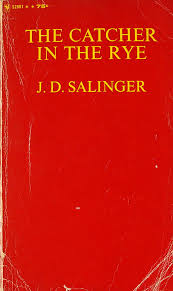 ding; nor can I remember if I liked the book or not. I have no recollection of the impression, if any, the story made on me as a teen, nor did I remember much of the plot. The only thing that has stuck in my memory over the years is that the lead character, Holden Caulfield, was plagued by a relentless moroseness and aimed his disgust at what teenagers typically target in their bid to be individuals – the system, adults, commercialism. What I took away from my first read of the book was a true understanding about the idea of ‘voice’ in literature, here was an author who used the voice of a teenager to convey his message.
Catcher is one of those books referred to in reverential terms as “the voice of a generation”. As good literature frequently does, it struck a chord. Written in 1951, it captured the angst, dissatisfaction, fear and loneliness bubbling beneath the surface of the post-war generation. It conveyed the emotions and words for youth who, like many before and many since, were suffering from a cultural aphasia preventing them from expressing it themselves. In so doing, J.D. Salinger opened a dialogue, even if he then swiftly retreated into his own self-imposed exile from that generation. As Washington Post columnist Ron Charles recently noted, “Holden [was] Patient Zero for generations infected by his misanthropy.”
It’s not surprising that the twitter sphere has taken some cracks at tweeting on Holden’s behalf, but there is not a barrage of fan rewrites or add-ons to the book. Salinger limited the marketing and proliferation of Holden from the very beginning. No sequel followed, no screen or stage adaptation. He steadfastly refused to allow Holden to become anything other than what he was – a character between the covers of a book.
So, Holden remains as he always has been, never really fitting in wherever he goes – with his family, at school, during his romp through New York. From the outset, he is damaged, whether by loss of his brother or his own loneliness, it’s never clear. What is evident when I re-read Catcher, is that he is alone, negotiating that horrible time in adolescence when you are old enough to know there are expectations, but too young to really understand them. In the opening pages, Holden stands on a hill overlooking the school he has just been kicked out of, and the students who have just ostracized him, (“…because practically the whole school except me was there…”). And as the story moves along, Holden throughout remains isolated and alone.
Literary analysts have noted that Holden envisions himself as the “catcher” of innocents, standing on the edge of the field, trying to catch other children as they come out of the “rye” into the world of experience. And yet, as his little sister tells him in the book, Holden has the lines wrong from a Robert Burns’ poem. The line is actually “If a body meet a body”, not catch. The entire novel is evidence of this, as we follow Holden through his romp with adulthood, living what he believes the adult life to be – in bars, hotels and in the company of a prostitute.
But, I would argue that the heart of the novel, and what permeates every single exchange that Holden has, is his deep loneliness and his desperation to connect. He decries all the phonies, but is drawn to anyone even though his inner monologue reveals his contempt. His teacher who he goes out of his way to visit but is repulsed by as soon as he sees him (“… old Spencer had on this very sad, ratty old bathrobe that he was probably born in or something”); his classmates who he can’t stand, but whom he keeps engaging in conversation to stave off being alone (“I didn’t answer him. All I did was, I got up and went over and looked out the window. I felt so lonesome, all of a sudden. I almost wished I was dead.”); the phone calls he makes to various girls, all of whom he professes to find ridiculous, but yet he can’t stop himself reaching out; the strangers from the taxi driver to the girls in the bar, right up to the prostitute, in whom he seeks solace and human connection, but whom he professes also disgusts him (“They didn’t invite me to sit at their table – mostly because they were ignorant – but I sat down anyway.”)
And yet, Holden also has moments of deep compassion and mature insights (“It’s funny. All you have to do is say something nobody understands and they’ll do practically anything you want them to.”), and a capacity to love (“Then she turned her back on me again. It nearly killed me, but I didn’t say anything.)” Does any of this sound familiar? If the internet could be personified into a single character, it would be Holden Caulfield.
Holden, like all of us, is a complex creature with love, hate and everything in between bubbling inside of him. He is the every man represented through a teenage boy, a boy perched on the edge of manhood struggling to divest himself of the harsh judgment and emotional intensity of adolescence, before the edges of adulthood dull the emotive colours from his world. Salinger’s genius in Holden is creating an amplified version of us, by harnessing the raw intensity of the teenage voice.
Rereading the novel, I can’t help but wonder what Holden’s ‘voice’ would have been had he had access to the current suite of social media tools available today. Would Holden’s “phonies” be the target of social media campaigns? Would he use anonymous twitter accounts to tell them all what he really thought of them?
I question whether the current culture of over-sharing, media darlings, and shock entertainment would have left any innocence with which Holden could grapple. If he had grown up in a world where school shootings are common place, celebrities are created by their willingness to have their lives broadcast, and youth have learned to eschew concepts of privacy thanks to Instagram and SnapChat, what would Holden’s disaffection look like?
And while I pondered this question, it dawned on me that I hear Holden’s voice all the time. It is there in every sardonic, derisive, or immature tweet. It’s there every time a Twitter war starts over an ill-thought off-handed comment. The only difference is that while most of Holden’s perceptions of people, and the world, remained within the confines of his narrative in the story, today’s youth have no aversions to broadcasting their thoughts. Catcheris told in the first person, and while we learn through dialogue how skewed Holden’s perspective is, we still see the world through his eyes. But, his thoughts and opinions stay largely in his own head. Today, Twitter, Instagram and a myriad of social media platforms allow us to learn what is going through the minds of every single person living in their own Holden moments. Periods of loneliness, anger, dismay and just plain moroseness come out easily as vicious and spiteful, easily slipping out from behind the mask of a computer or smart phone.
We don’t need a writer’s imagination to visualize what Holden would be like today. We only need to spend 10 minutes on the Twitter-sphere to know that the world is filled with modern Holdens, who voice daily their contempt, pain, and confusion, but also their wonder and love, through the social media platforms of their choosing. Unlike Holden though, we no longer have a sense of innocence. We are now on an endless march towards virtual experience.
Perhaps that is why Catcher remains relevant 68 years after it was originally published. There have been 3 or 4 generations since the novel made its debut, and yet little seems to have changed in the human condition. We still lash out in loneliness and pain, still seek to find the external causes of our hurt (“the phonies”), the only difference is that we no longer need to make our way through a book to read all about it.
Salinger was notoriously reclusive, and we will never know what truly motivated his Holden, but he created an iconic character who still resonates today and has become an enduring cultural legacy. Holden is us, and we are Holden. ‘Twas ever thus.

 Median Mama